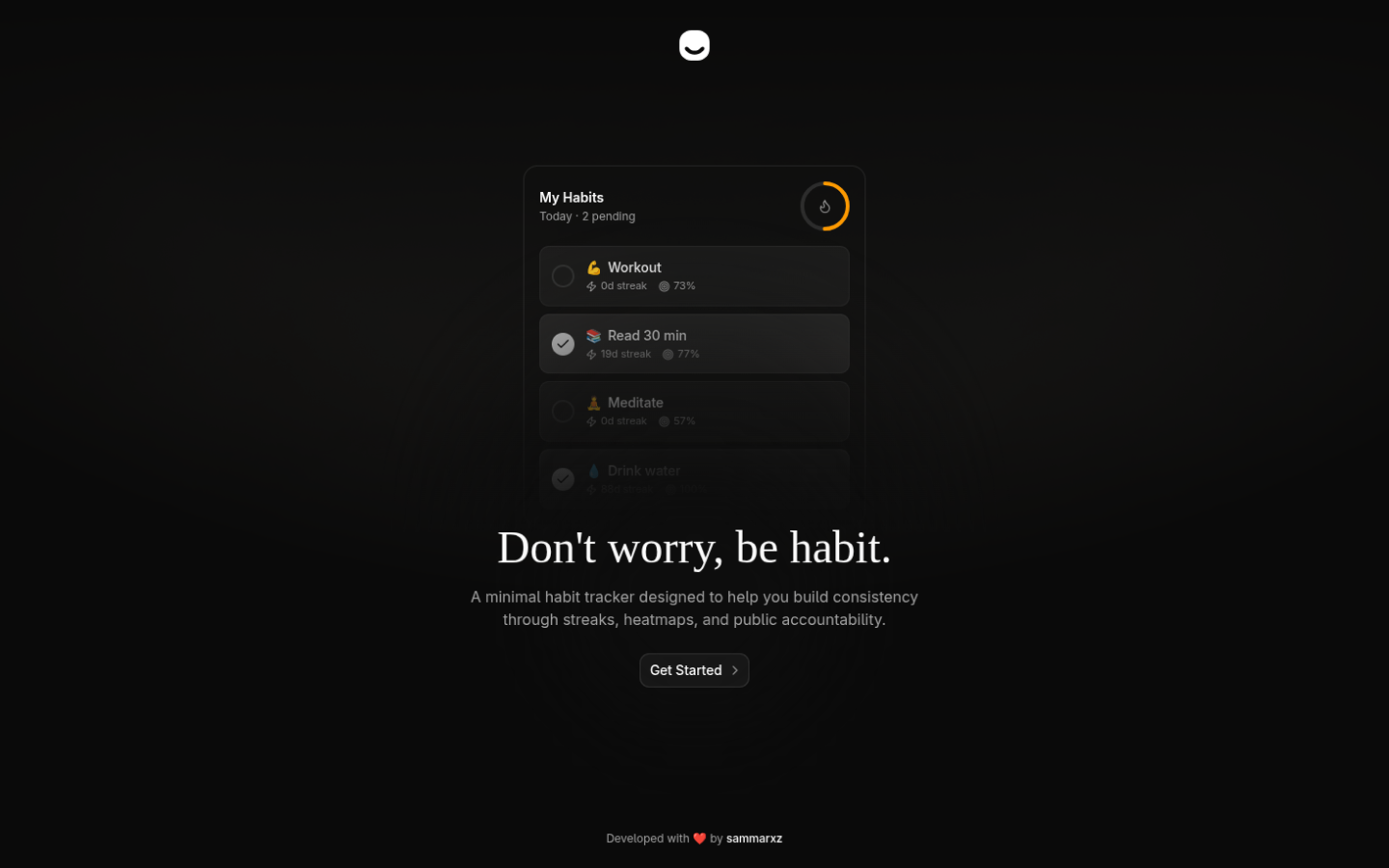
Every developer has that app they wish existed. Mine was a habit manager that wasn’t just another checkbox tracker, something that gave me a tangible reason to stay consistent. I wanted to define my own rewards: accumulate points by completing habits and use those points to “buy” something I set as a goal. A new book upon reaching 100 points. An afternoon off after completing 30 consecutive days of training. My rules, my rewards.
I couldn’t find anything that did exactly that, so I decided to build it. Behabit was born.
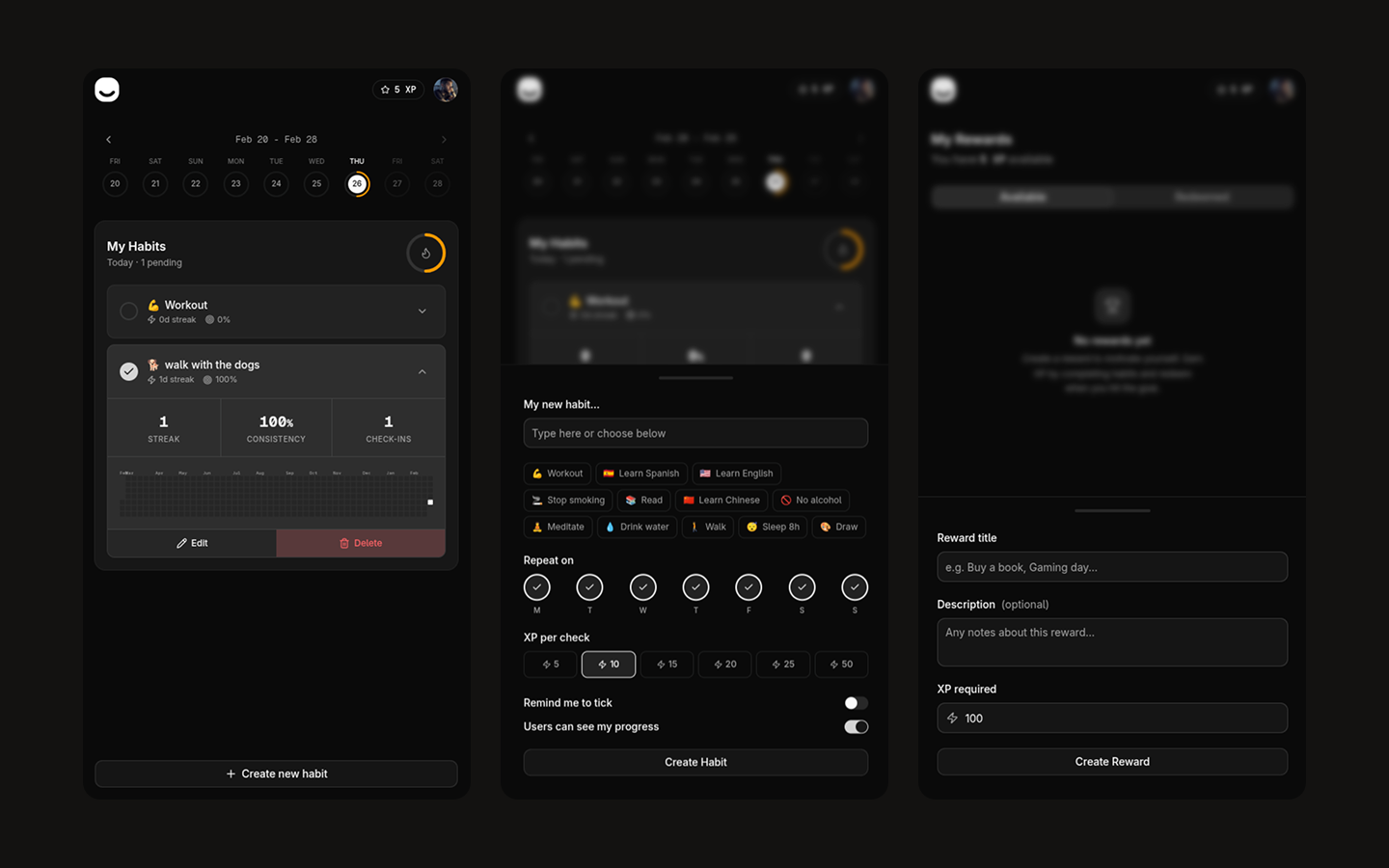
The project became a PWA MVP with the potential to evolve into a mobile app. The interface is dark, clean, and fully focused on the mobile experience, no distractions, with visual feedback (confetti, sounds, animations) that makes completing a habit satisfying.
Why this project matters for my career now
I have solid experience in front-end development. React, TypeScript, responsive interfaces, accessibility, design systems, this is my known territory. But I am currently in a deliberate transition: I want to become a full-stack developer with an emphasis on back-end.
Behabit was a real opportunity to put that to the test. Not just consuming a ready-made API, but designing and building the entire server layer: database modeling, authentication, services, routes, and the contracts between front and back. Every technical decision I made here was intentional, and every mistake was a lesson that doesn’t exist in any tutorial.
The stack and technical choices
Frontend: Next.js 15 (App Router) + React 19 + TailwindCSS v4 Backend: ElysiaJS (Bun runtime) ORM: Drizzle ORM Database: PostgreSQL Auth: Better Auth State: TanStack Query (React Query) Deploy: Docker + Docker Compose PWA: Serwist
Why ElysiaJS?
This was the choice furthest from my comfort zone. ElysiaJS is a web framework for the Bun runtime, focusing on performance and Developer Experience (DX). What attracted me was the end-to-end type system with Eden, the same validation schema from the server can be consumed on the client with automatic type inference. In smaller projects and MVPs, this eliminates a lot of boilerplate.
The server runs in parallel with Next.js during development:
"dev": "concurrently --names next,api --prefix-colors blue,green \"next dev\" \"bun --watch server/index.ts\""Two processes, one integrated development experience.
Data modeling: where it all begins
The first real back-end decision was the schema. With Drizzle ORM, the schema is pure TypeScript, no separate DSL, no extra configuration files.
export const repeatEnum = pgEnum("repeat", ["daily", "weekly", "monthly"])

export const habits = pgTable("habits", {
id: uuid("id").primaryKey().defaultRandom(),
userId: text("user_id")
  .notNull()
  .references(() => user.id, { onDelete: "cascade" }),
name: text("name").notNull(),
emoji: text("emoji").notNull().default("⭐"),
repeat: repeatEnum("repeat").notNull().default("daily"),
selectedDays: jsonb("selected_days")
  .notNull()
  .$type<boolean[]>()
  .default([true, true, true, true, true, true, true]),
remindMe: boolean("remind_me").notNull().default(false),
reminderTime: text("reminder_time"),
xpPerCheck: text("xp_per_check").notNull().default("10"),
isPublic: boolean("is_public").notNull().default(true),
createdAt: timestamp("created_at").notNull().defaultNow(),
updatedAt: timestamp("updated_at").notNull().defaultNow(),
})

export const habitCompletions = pgTable(
"habit_completions",
{
  id: uuid("id").primaryKey().defaultRandom(),
  habitId: uuid("habit_id")
    .notNull()
    .references(() => habits.id, { onDelete: "cascade" }),
  date: text("date").notNull(), // YYYY-MM-DD
  completed: boolean("completed").notNull().default(true),
  createdAt: timestamp("created_at").notNull().defaultNow(),
},
(table) => [unique().on(table.habitId, table.date)],
);

export const rewards = pgTable("rewards", {
id: text("id").primaryKey().$defaultFn(() => crypto.randomUUID()),
userId: text("user_id")
  .notNull()
  .references(() => user.id, { onDelete: "cascade" }),
title: text("title").notNull(),
description: text("description"),
emoji: text("emoji").notNull().default("🏆"),
xpRequired: integer("xp_required").notNull(),
isRedeemed: boolean("is_redeemed").notNull().default(false),
redeemedAt: timestamp("redeemed_at"),
createdAt: timestamp("created_at").notNull().defaultNow(),
updatedAt: timestamp("updated_at").notNull().defaultNow(),
})
What I learned here:
The decision to store date as text("YYYY-MM-DD") instead of a timestamp was deliberate. Habits live in the context of the user’s local day, not UTC. Storing it as a string eliminates all timezone headaches in the database, conversion happens only at the edges of the system. It was a small decision with a big impact.
The unique().on(table.habitId, table.date) constraint ensures there are no duplicate completions for the same habit on the same day, business logic guaranteed at the data layer, not just in the application.
The XP and reward logic
Behabit’s core mechanics live in pure functions shared between front and back, TypeScript bridging both worlds:
export function calculateTotalXP(habits: Habit[]): number {
return habits.reduce((total, h) => {
  const checkIns = Object.values(h.activities).filter(Boolean).length
  return total + checkIns * (h.xpPerCheck || 0)
}, 0)
}

export function calculateSpentXP(rewards: Reward[]): number {
return rewards.filter((r) => r.isRedeemed).reduce((total, r) => total + r.xpRequired, 0)
}

export const calculateStreak = (activities: Record<string, boolean> | undefined): number => {
if (!activities) return 0
let streak = 0
const today = new Date()
for (let i = 0; i < 365; i++) {
  const date = new Date(today)
  date.setDate(today.getDate() - i)
  const dateString = date.toISOString().split("T")[0]
  if (activities[dateString]) {
    streak++
  } else {
    break
  }
}
return streak
}
Available XP is always totalXP - spentXP. Simple, auditable, with no magic state in the database. When the user redeems a reward, the isRedeemed field is set to true and the spent XP is recalculated, the source of truth is always the completion history.
Services: separating responsibilities
One of the biggest lessons was organizing the service layer cleanly. Each entity has its own service file with pure functions that receive userId as the first argument, ensuring that no operation happens without the context of the authenticated user.
export async function toggleHabitCompletion(userId: string, habitId: string, date: string) {
// 1. Verify that the habit belongs to the user
const [habit] = await db
  .select()
  .from(habits)
  .where(and(eq(habits.id, habitId), eq(habits.userId, userId)))

if (!habit) return null

// 2. Check if a completion already exists for this date
const [existing] = await db
.select()
.from(habitCompletions)
.where(and(eq(habitCompletions.habitId, habitId), eq(habitCompletions.date, date)))

if (existing) {
if (existing.completed) {
// Toggle off: delete
await db.delete(habitCompletions).where(eq(habitCompletions.id, existing.id))
return { date, completed: false }
} else {
// Toggle on
await db.update(habitCompletions).set({ completed: true }).where(eq(habitCompletions.id, existing.id))
return { date, completed: true }
}
} else {
// Create new completion
await db.insert(habitCompletions).values({ habitId, date, completed: true })
return { date, completed: true }
}
}
The same pattern applies to reward redemption, ownership verification before any mutation, returning null when not found, and the controller (route) deciding the HTTP status:
export async function redeemReward(userId: string, rewardId: string) {
const [existing] = await db
  .select()
  .from(rewards)
  .where(and(eq(rewards.id, rewardId), eq(rewards.userId, userId)))

if (!existing) return null
if (existing.isRedeemed) return null

const [updated] = await db
.update(rewards)
.set({
isRedeemed: true,
redeemedAt: new Date(),
updatedAt: new Date(),
})
.where(eq(rewards.id, rewardId))
.returning()

return rewardToResponse(updated)
}
Routes with ElysiaJS: validation as a contract
ElysiaJS has an integrated validation system with TypeBox that impressed me. Body validation is not a separate middleware, it’s part of the route definition and generates TypeScript types automatically:
export const habitRoutes = new Elysia({ prefix: "/api/habits" })
.use(authMiddleware)
.onBeforeHandle(({ user, set }) => {
  if (!user) {
    set.status = 401
    return { error: "Unauthorized" }
  }
})
.post(
  "/:id/toggle",
  async ({ user, params, body, set }) => {
    const result = await toggleHabitCompletion(user!.id, params.id, body.date)
    if (!result) {
      set.status = 404
      return { error: "Habit not found" }
    }
    return result
  },
  {
    params: t.Object({ id: t.String() }),
    body: t.Object({
      date: t.String({ pattern: "^\\d{4}-\\d{2}-\\d{2}$" }),
    }),
  }
)
The regex in the date field ensures the YYYY-MM-DD format even before reaching the service. This is validation at the edge, where it should be.
Authentication with Better Auth
I chose Better Auth instead of implementing JWT manually because I wanted to focus on product features, not auth infrastructure. Its integration with Drizzle was straightforward, and support for OAuth (GitHub and Google) came at no extra cost:
export const auth = betterAuth({
database: drizzleAdapter(db, {
  provider: "pg",
  schema: { user, session, account, verification },
}),
emailAndPassword: { enabled: true },
socialProviders: {
  github: {
    clientId: env.GITHUB_CLIENT_ID ?? "",
    clientSecret: env.GITHUB_CLIENT_SECRET ?? "",
  },
  google: {
    clientId: env.GOOGLE_CLIENT_ID ?? "",
    clientSecret: env.GOOGLE_CLIENT_SECRET ?? "",
  },
},
user: {
  additionalFields: {
    username: { type: "string", required: false, unique: true },
  },
},
})
The username field was an important addition: it allows for public profiles where other users can see habits marked as isPublic: true.
The side I already knew: the mobile experience
With the back-end structured, the front-end felt more natural. However, there were still relevant lessons. The useDashboard hook was where all the dashboard state logic consolidated, including a non-obvious solution to the timezone problem:
const visibleHabits = useMemo(() => {
// Using T12:00:00 prevents timezone conversion from changing the day
const date = new Date(selectedDate + "T12:00:00")
// JS getDay(): Sun=0…Sat=6 → app selectedDays: Mon=0…Sun=6
const dayIndex = (date.getDay() + 6) % 7

return habits.filter((habit) => {
if (!habit.createdAt) return true
const createdDateStr = new Date(habit.createdAt).toISOString().split("T")[0]
if (createdDateStr > selectedDate) return false
return habit.selectedDays[dayIndex] === true
})
}, [habits, selectedDate])
The problem: new Date("2024-01-15") is interpreted as UTC midnight, and depending on the user’s timezone, it could result in the previous day. Fixing the time at T12:00:00 ensures the date remains correct regardless of the timezone. This type of bug only appears in production, with real users in different timezones.
PWA and habit notifications
Transforming the application into a PWA with Serwist added capabilities that were essential to the product’s value proposition: mobile installability and habit reminder notifications.
The PWA-first architecture was a conscious choice: the cost of developing a native app (React Native, Expo) is significantly higher for an MVP. PWAs deliver ~80% of the mobile experience with the same codebase.
Deploy: Docker Compose to separate front and back
The separation between Next.js and ElysiaJS required a docker-compose.yml with two distinct services. This was a practical lesson in Docker networks, production environment variables, and the build cycle of a monorepo:
services:
web:
  build:
    context: .
    dockerfile: Dockerfile.web
  ports: ["3000:3000"]
  depends_on: [api, db]

api:
build:
context: .
dockerfile: Dockerfile.api
ports: ["3001:3001"]
depends_on: [db]

db:
image: postgres:16-alpine
volumes: [postgres_data:/var/lib/postgresql/data]
What’s left for future versions
Behabit is functional as an MVP, but there are clear items on the roadmap:
- Offline mode with sync: service worker to cache data and synchronize when the connection returns.
- Native mobile app: migrate to React Native while keeping the shared business logic.
- Advanced statistics: consistency charts by period, activity heatmap.
- Social habits: follow friends, view public progress, group challenges.
Final reflection
Behabit taught me that the biggest difference between front-end and full-stack isn’t technology, it’s mindset. In the front-end, you consume a contract. In the back-end, you are responsible for it. Every schema field, every route validation, every ownership check before a mutation, these are decisions that impact security, data consistency, and user experience in ways the front-end never sees.
Stepping out of the comfort zone of beautiful interfaces to design a system that works correctly, doesn’t leak one user’s data to another, handles errors gracefully, and maintains consistency under concurrency, this changed my perspective as a developer.
I am building other projects with this same mindset: start from a real need, design the back-end architecture first, and let the user experience emerge from a solid foundation.
This project is part of my portfolio under construction. The code is available on GitHub.
Stack summary: Next.js 15 · React 19 · ElysiaJS · Bun · Drizzle ORM · PostgreSQL · Better Auth · TanStack Query · TailwindCSS v4 · Docker · PWA (Serwist)